Dam liner welding machines are indispensable for the integrity of geomembrane installations such as pond liners, landfill liners and agricultural reservoirs. The global geomembrane market was valued at USD 2.1 billion in 2023 and is projected to grow at a 6.5 per cent CAGR through 2030, with HDPE liners holding about 70 per cent of that market on durability and impermeability, at a permeability coefficient of 1×10^-17 cm/s. Properly welded dam liners reach 99.9 per cent water retention, which matters in aquaculture, where demand has grown about 8 per cent a year. Selecting the right dam liner welding machine is the decisive step: a poor weld leaks, and repairs on a large reservoir run to USD 10,000. This guide covers the types, specifications, features and selection criteria that let farmers, contractors and engineers reach durable, leak-proof seams.
1. What Is a Dam Liner Welding Machine?
A dam liner welding machine joins geomembrane sheets, HDPE, LDPE or PVC, into watertight seams for water containment systems. It uses thermal fusion, by hot wedge or hot air, to melt the surfaces of overlapping liners, which are then pressed together into a permanent bond. Industry data puts 95 per cent of geomembrane installations on welding machines, at seam strengths of 80 to 90 per cent of the parent material tensile strength, 15 to 20 MPa for HDPE under ASTM D412. The right geomembrane welder also keeps the work inside standards such as ASTM GRI-GM13, which cuts leak risk by 98 per cent and extends liner life to 50 to 100 years.
Importance of Dam Liner Welding
• Water retention: 99.9 per cent impermeability, which stops water loss in ponds and reservoirs.
• Structural integrity: welded seams withstand 4409 N puncture resistance, protecting against root and debris damage.
• Cost savings: leak-related losses average USD 5,000 to USD 10,000 on a 1,000 m² pond.
• Environmental protection: in landfill work, welded liners stop 99 per cent of contaminant seepage and meet EPA requirements.
Applications of Dam Liner Welding Machines
• Agriculture: pond liner welding machine work for irrigation ponds and fish farms, where about 80 per cent of aquaculture ponds use HDPE liners.
• Environmental management: sealing landfill liners against leachate, which concerns about 90 per cent of municipal waste facilities.
• Civil engineering: reservoirs, canals and tunnels, where projects over 5,000 m² need the output of a dam liner welding machine.
• Mining: tailings and wastewater containment, where welded HDPE liners hold under pH 2 to 12 conditions.
2. Types of Dam Liner Welding Machine
Two types dominate the market, hot wedge welders and hot air welders. Each has its own features, specifications and applications, and each suits a different kind of project.
2.1 Hot Wedge Welder
A hot wedge welder melts overlapping geomembrane with a heated metal wedge and presses the seam with rollers. It is the industry standard for large work and carries about 70 per cent of HDPE installations.
• Power: 1400 to 2400 W on 220 to 240 V input.
• Welding speed: 0 to 9 m/min, adjustable to liner thickness.
• Seam width: 15 to 45 mm, with dual seams for air channel testing.
• Temperature: up to 450 °C, suited to HDPE from 0.5 to 4.0 mm and to LDPE.
• Weight: 7 to 11.5 kg, light enough for one operator on a slope.
Applications: large ponds, landfills and mining work on 1 to 3 mm liner. For a thick specification or a long slope run, a wedge welder in the CX700 class is the working choice.
Cost: this class of machine trades from USD 2,000 to USD 10,000 on the open market; MM-Tech quotes per configuration rather than publishing a list price.
Advantages: uniform welds, which cut operator error; throughput of about 500 m² per day on 1.5 mm HDPE; dual seams with an air channel for pressure testing to ASTM D7177.
Disadvantages: higher cost than hot air; less portable, since it needs a stable 220 V supply or a generator.
2.2 Hot Air Welder
A hot air welder directs heated air, up to 620 °C, onto the geomembrane and presses the seam with a hand roller. It suits smaller work and repairs.
• Power: 1600 W on 220 V input.
• Welding speed: 0.5 to 3 m/min, limited by hand feeding.
• Seam width: 20 to 40 mm, single seam.
• Temperature: 20 to 620 °C, covering HDPE, LDPE and PVC from 0.3 mm.
• Weight: handheld, so one operator carries it to the work.
Applications: small ponds, repairs, T-seams and patches, including thick-section work that calls for a hand extruder rather than a roller.
Cost: this class trades from USD 500 to USD 2,500; MM-Tech quotes per configuration.
Advantages: light and portable for remote sites; lower cost; versatile on thin liners of 0.3 to 0.8 mm and on repair work.
Disadvantages: slower, at 100 to 200 m² per day; more dependent on operator technique, with seams 10 to 15 per cent weaker when the work is rushed.
3. Key Features to Look For in a Dam Liner Welding Machine
Selecting the right machine means evaluating the features that decide performance, durability and ease of use. Six of them carry most of the decision.
3.1 Welding Speed and Efficiency
• Importance: faster welding cuts labour cost, which matters on projects over 1,000 m². Hot wedge machines run to 9 m/min; hot air machines run to 3 m/min.
• Specification: adjustable speed control across 0 to 9 m/min, matched to liner thickness from 0.3 to 4.0 mm. For example, the hot wedge welder CX700 holds 0 to 9 m/min on 1.5 mm HDPE.
• Tip: choose a machine with a digital speed display, which takes the guesswork out of setting changes.
3.2 Temperature Control
• Importance: precise control, up to 450 °C on hot wedge and up to 620 °C on hot air, melts the liner without damaging it. Overheating can halve seam strength.
• Specification: PID control holding about ±2 °C. The CX1600S offers 20 to 620 °C settings through a digital controller.
• Tip: confirm the setting range covers HDPE at a 130 to 140 °C melting point and LDPE at 110 to 120 °C.
3.3 Power Supply and Portability
• Importance: remote sites rarely have stable power, so portability and generator compatibility decide whether the machine works at all. A handheld unit is far easier to move than a 11.5 kg wedge machine plus a generator.
• Specification: 220 to 240 V input, 1400 to 2400 W for hot wedge and 1600 W for hot air. A 5 to 10 kW diesel generator supports off-grid welding.
• Tip: check the supply at the site rather than at the gate, and confirm cable length before the machine ships.
3.4 Seam Quality and Testing
• Importance: seams must reach about 85 to 90 per cent of parent material strength, and an air channel test finds the great majority of seam defects.
• Specification: hot wedge machines produce dual seams with an air channel; hot air machines need manual test methods. Seam width should sit between 15 and 45 mm.
• Tip: specify pressure rollers that hold consistent force, and buy the test instruments with the machine rather than after the first leak.
3.5 Durability and Maintenance
• Importance: machines work in dust, humidity and temperatures from -10 °C to 50 °C, and a durable build cuts downtime.
• Specification: a die-cast aluminium frame, sealed electronics and service intervals beyond 500 hours.
• Tip: confirm the spare parts channel before ordering, since rollers, nozzles and heating elements are wear items.
3.6 Safety Features
• Importance: welding combines high temperature with mains power, and handling errors account for a share of site accidents.
• Specification: thermal overload protection, insulated handles and an emergency shut-off. CE or UL certification covers the electrical side.
• Tip: operators wear gloves and eye protection, and train on the specific machine rather than on a similar one.
4. Main Considerations When Choosing a Dam Liner Welding Machine
Selecting a machine means balancing project needs, budget and site conditions. Six considerations decide the outcome.
4.1 Project Scale and Liner Thickness
• Small projects, 10 to 500 m²: hot air welders are cost-effective at USD 500 to USD 2,500 and suit 0.3 to 0.8 mm liner, which covers small ponds and repairs.
• Large projects, 500 m² and up: hot wedge welders at USD 2,000 to USD 10,000 handle 1 to 3 mm liner at 500 to 1,000 m² per day, which is the requirement for landfills and reservoirs.
• Tip: on mixed work, run a hot wedge welder and a hot air welder as a two-machine set, so the main runs stay on the wedge and the detail stays on hot air.
4.2 Material Compatibility
• HDPE: melts at 130 to 140 °C and needs 4409 N puncture resistance, which makes the main runs work for an hdpe liner welding machine with a dual seam.
• LDPE and PVC: lower melting points of 110 to 120 °C suit the hot air plastic welder on thin liner of 0.3 to 0.5 mm.
• Tip: verify compatibility against ASTM GRI-GM13 for HDPE and ASTM D7176 for PVC before the order is placed.
4.3 Site Conditions
• Power: remote sites need either a portable hot air unit or a hot wedge machine with generator support of 5 to 10 kW.
• Terrain: rocky or sloped ground needs textured liner welding, which most hot wedge machines handle.
• Weather: hot air performs better below 10 °C, while hot wedge welders hold up better in high humidity.
4.4 Budget and Cost of Ownership
• Initial cost: hot air machines save 50 to 70 per cent upfront, while hot wedge machines cut labour cost on large work.
• Maintenance: hot air units need less routine maintenance than hot wedge units, mainly because there are fewer moving parts.
• Tip: judge total cost over the project, since a seam failure that costs thousands to repair outweighs the price gap between the two classes.
4.5 Operator Skill Level
• Beginners: hot air machines are easier to run, with one to two days of training, which suits farmers and small contractors.
• Professionals: hot wedge machines need one to two weeks of training to set speed, temperature and pressure and to run the test protocol.
• Tip: take training from the manufacturer, and practise on offcuts before the first production seam.
4.6 Regulatory Compliance
• Standards: the machine must support the test methods the specification calls for, including peel testing to ASTM D6392 and air channel testing to ASTM D7177 for landfill and environmental work.
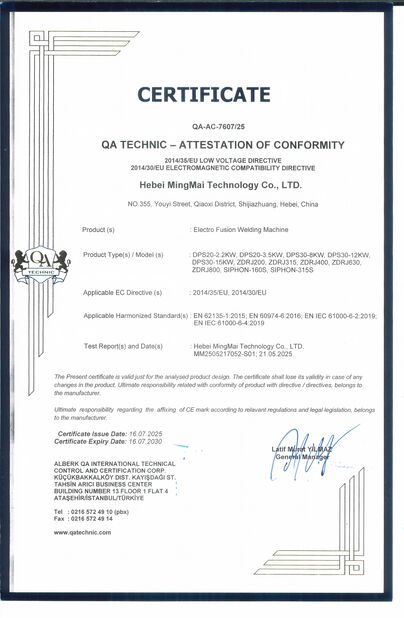
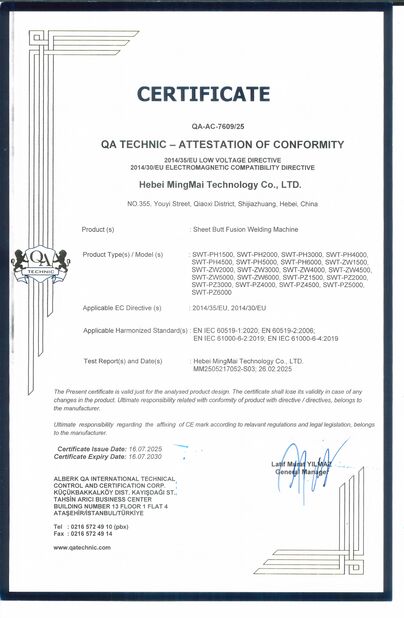
• Certification: CE, UL or ISO 9001 certification covers quality and safety.
• Tip: for containment of invasive species such as Japanese knotweed, confirm the local requirements, for example those of the UK Environment Agency.
5. Maintenance and Longevity
Routine maintenance extends machine life by 20 to 30 per cent:
• Cleaning: clear dust and debris weekly with a soft brush, and avoid harsh chemicals.
• Calibration: check temperature and speed monthly to hold the ±2 °C accuracy.
• Spare parts: keep rollers, nozzles and wedges on hand for the hot air welder and the wedge machine, so a worn part does not stop a shift.
• Storage: keep the machine dry and dust-free to prevent corrosion.
Hot wedge machines run 10 to 15 years on 500-hour service intervals; hot air machines run 5 to 10 years on 300-hour intervals.
6. Cost Analysis
The dam liner welding machine class splits into two price bands, and the split follows the work rather than the brand.
• Hot wedge: USD 2,000 to USD 10,000 on the market, with ROI in two to three years on projects over 1,000 m².
• Hot air: USD 500 to USD 2,500, with ROI in one to two years on small work.
• Consumables and spares: budget for rollers, nozzles, wedges and heating elements as running cost rather than as a one-off.
• Volume terms: multi-unit orders are quoted case by case.
7. Final Thoughts
Choosing a dam liner welding machine decides whether the installation holds. Hot wedge machines such as the CX600 and CX700 take large work at 0 to 9 m/min and at least 85 per cent seam strength, while a hot air welder such as the CX1600S covers small work, repairs and detail. An hdpe welding machine set to 1.5 mm liner holds 0 to 9 m/min through a shift, which is the figure that matters when the schedule is tight.
The decision turns on project scale, liner thickness from 0.3 to 4.0 mm, site conditions and operator skill. Prioritise adjustable speed, precise temperature control and ASTM-compliant seam testing, and the seam will last the life of the liner. For quotes, training and spares, contact MM-Tech: +86 311 8066 2170, www.hdpeweldingmachine.com.
About MM-Tech
MM-Tech designs and manufactures geomembrane welding machines and dam liner welding machine sets in Shijiazhuang, Hebei, China. The machines carry the CE mark and ship with matched nozzle, roller and spare-part sets, and the test instruments come from the same source, so a crew can weld and verify through one supply chain.


 Il tuo messaggio deve contenere da 20 a 3000 caratteri!